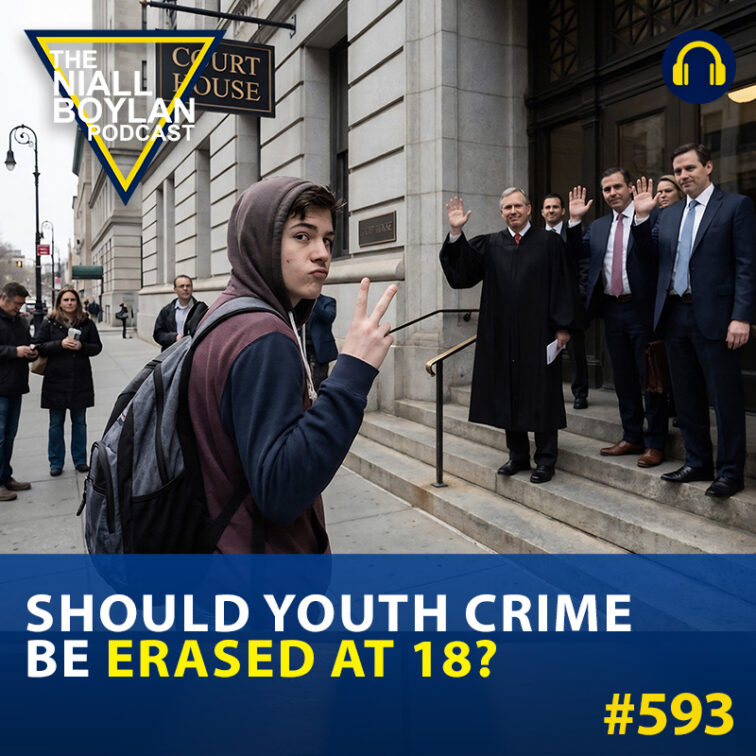
Should Youth Crime be erased at 18? Episode 593
-
play_circle_filled
Should Youth Crime be erased at 18? Episode 593
Niall Boylan
In this episode, host Niall is joined by Laoise Da Brun, Barrister-at-Law, and Karl Deeter, political commentator, to tackle a contentious legal and moral question: Should criminal convictions committed as a minor be wiped clean once a person reaches adulthood?
The UK is now considering following Ireland’s approach, where most criminal offences committed under the age of 18 become spent after three years — provided there are no further convictions. In practical terms, this means those offences no longer appear on a person’s criminal record once they reach adulthood, allowing them to move on without the shadow of past mistakes.
Supporters of the system argue that it reflects a realistic understanding of youth behaviour and brain development. Teenagers, they say, are more impulsive, more susceptible to peer pressure, and still forming their moral judgement. Giving young people a clean slate can improve access to education, employment and housing, reducing the likelihood of reoffending and helping them become productive members of society. From this perspective, lifelong punishment for adolescent mistakes may do more harm than good.
But critics raise serious concerns. What about individuals who commit repeated or serious offences at 16 or 17? Should a long pattern of criminal behaviour simply disappear on paper at 18? There are fears that such policies may weaken accountability, undermine public confidence in the justice system, and send the wrong message — that youthful crimes carry no lasting consequences. Victims’ rights and public safety also feature prominently in the debate.
Together, Niall, Laoise and Karl explore the legal framework, ethical tensions and real-world consequences of expunging juvenile convictions. Is this policy a compassionate, evidence-based approach to justice — or an overly lenient system that risks encouraging bad behaviour? And if the UK adopts Ireland’s model, where should the line be drawn?
A thoughtful and robust discussion on fairness, responsibility and whether society should believe in second chances — or lasting consequences.